The Jeopardy! Experience
11. More Revelations
As I struggled with the wardrobe rack, Lynn continued to tell me about Jeopardy!. After entering the studio, Glen outlined the day’s schedule. He told them that filming starts at 2:00 PM. They film three shows, with a fifteen-minute break between shows for Alex and the returning champion to change clothes. Then, between games three and four, there’s a short lunch break: a buffet is set up on the sound stage next door. No one can leave the building until they’re done filming all five episodes. Filming resumes at 5:00 PM with a new studio audience and continues until they have five shows “in the can,” usually between 6:30 and 7:00 PM.
Next, Glen explained that they film live. They “start tape” at the beginning of each episode and try not to “stop tape“ until the show's end. When they come to a commercial, the tape keeps going, and the break lasts precisely as long as the commercials, which are woven in later in post-production. The only time they “stop tape” is before Final Jeopardy. The clue crew will come out with paper and a calculator so you can accurately figure out your wager. They are the people you see hovering around the contestants in the dimly lit studio between the two sets of commercials before Final Jeopardy. The crew allows the contestants as much time as they need for this, and asks each if they’re sure about their wager. Finally, they’ll tell you to write the beginning of the Final Jeopardy question—“What is…” or “Who is...”—on the magic electronic display slate. When everyone’s ready, the “The Dress” claps them back in.
Glenn told them if Alex makes a mistake (but quickly added with a smile that Alex doesn’t make mistakes), the game doesn’t stop. He said they should read and try to answer the clue, even if Alex doesn’t finish reading it. Signal in when you see the lights around the board go on (more about those lights later), and answer as if nothing went wrong. It’s why they keep the tape rolling: Alex rereads the clues he’s not happy with during the commercial break. They dub Alex’s correction back in during post-production. And, if you dispute an answer, you’re not supposed to say anything until the commercial break. Then, the judges will research your challenge and adjust the scores during the break if needed. (You may have noticed this on rare occasions: Alex will announce an adjustment in the score when they return from a commercial break.) They don’t stop tape. If they have to stop tape—well, Lynn said Glenn told them, “It’s complicated. People get grumpy. We don’t stop tape!”
Then, Lynn said they all filed down to the floor of the ice-cold set. Each prospective contestant got to try the signaling device and practice writing with the light pen. Lynn said it’s tricky because there’s a slight delay as you write: the display takes half a second to catch up to what you’re writing. The crew also noted which ‘vertically challenged’ players needed boxes to stand on when behind their podium. The cameraperson hates to bob the camera up and down as they pan from player to player, so they try to make everyone the same height. Lynn’s box was black, the top of which had been scuffed to the point of exposing bare wood. She felt like she couldn’t move her feet for fear of falling off. There’s so much more to Jeopardy! than getting the right question.
Lights around the edges of the main board are another unseen thing. The signaling devices aren’t activated until Alex reads the entire clue. When the lights around the board, unseen by the TV viewing audience, come on, the signaling devices become active. If you try to signal in before the lights come on, you get locked out from signaling in again for a tenth of a second. The lights are there so that if Alex messes up reading a clue, one of the judges will activate the lights so the contestants can signal in and the game can continue without stopping the tape. Alex is unseen by the TV viewing audience when he’s reading the clue, so it’s just a matter of dubbing in new audio.
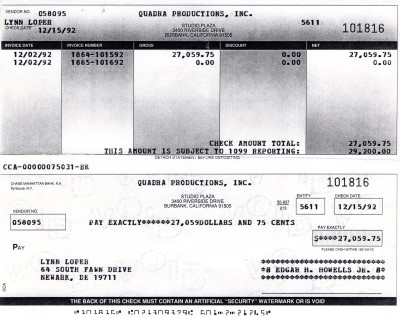
In late October 1992, we were grocery shopping at the Acme in Newark, Delaware. Lynn filmed the shows in August, but they weren’t aired until mid-October. The checker recognized Lynn. “Hey! You’re the Jeopardy! champion from Newark, aren’t you?!” she said, a little loudly. “I seen ya on the news!” There was a sudden twenty-foot circle of silence around Lynn as everyone stopped to look, broken just as suddenly by people clapping. “Wow! What was Alex like?” the checker asked. That was the second most asked question Lynn would get when people found out she’d been on Jeopardy! The first was, “How much did you win?” This was the first time Lynn had been recognized in public, and it caught her—and me—completely off guard. She was embarrassed but at the same time exhilarated. As people closed in to hear her, Lynn explained to the checker that the Alex you see on TV is as much of him as she sees. The only time contestants get to talk to him is when he’s on stage, ‘cause he knows all the answers. Then, answering distant queries, she added, “$29,200...a trip to Montreal...a year’s supply of Klondike Bars and Dentu-Grip.” Thinking back now, I remember the expressions on people’s faces. Because of Lynn, smiling people left the store with a story to tell, a happy story that began, “I met a Jeopardy! champion!”
Driving home, Lynn told me about seeing the president of the University of Delaware earlier in the day at work. She worked in the same building as the president; his office is in what the worker bees call “The Mahogany Corner.” She often passed him in halls of the building, but she’d always been one of the unseen—until Jeopardy!. He and the Provost were taking a group of IT executives to lunch at the faculty dining hall. As the group approached Lynn, walking in the other direction to her lonely, frugal lunch at The Malt Shop downtown, he suddenly said, “And here’s our Jeopardy! champion, Mrs. Loper. She’s in admissions. You may have just seen her on TV. Good afternoon, Mrs. Loper; so nice to see you.”
“It was weird,” Lynn said, as we carried in the groceries. I mentioned the smiling faces that had gone unseen by her at the grocery store. “It just doesn’t seem right,” she said. “It’s still just me in here.”
Remember the all-caps warning message that there was no guarantee that you’d appear on the show? There’s more, something unseen, or at least unconsidered. If the show you tape doesn’t air, you don’t get any prize money or lovely parting gifts. That’s right: no Dentu-Grip! We didn’t think much of it then; why wouldn’t it air? Why? A presidential campaign was going on in 1992, with debates between Clinton, Bush, and Perot. Lynn’s first game was supposed to air on Thursday, October 15th, at 7:00 PM Eastern Time. When the debate schedule was first announced in early October, the debate (the second of three) was slated to start at 8:00 PM on October 15th, with network coverage beginning at 7:00 PM with a “pregame” show. Jeopardy! would be preempted. Lynn’s show would never air. Lynn tried to act as though it didn’t matter. Being able to qualify for the show had always been her only goal. The fact that she got to film three episodes was rewarding enough. Her eyes said differently as I went to hug her.
Things unseen move beyond our knowing and understanding.
One candidate had a scheduling problem, so the debate was moved to 9:00 PM, and Jeopardy! aired at its usual time on October 15th, 1992. So, when Lynn, the sudden celebrity, returned from the Acme that afternoon in late October, we set our groceries down on the table Lynn had bought at Ikea with her Jeopardy! money, knowing that a check from Hollywood would be coming in December; a table that would have remained unseen but for a simple twist of fate.